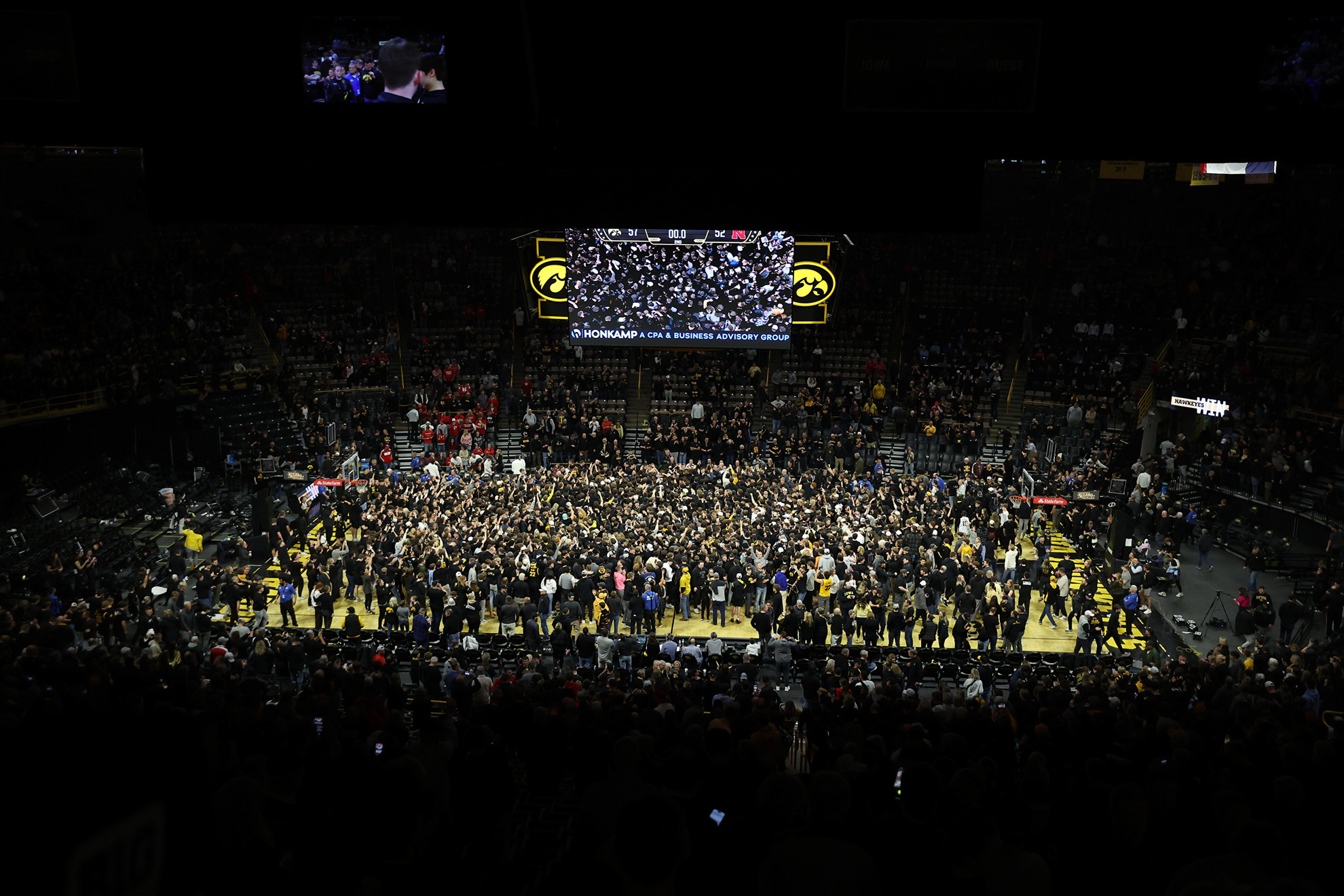
Iowa Downs No. 9 Nebraska: Court Stormed in Intense Border Rivalry
The raucous energy of Carver-Hawkeye Arena erupted into a chaotic celebration as Iowa Hawkeyes fans stormed the court, basking in the glory of a hard-fought 57-52 victory over their arch-rival, the No. 9 ranked Nebraska Cornhuskers. This thrilling upset on Tuesday night, February 17, 2026, was more than just another win; it was a testament to the enduring intensity of the
Nebraska Vs Iowa rivalry, a clash that spans far beyond the basketball court.
From the opening tip, the atmosphere was electric, charged with the simmering tension that only a border battle can bring. Despite a cold-shooting second half, particularly from beyond the arc, the Hawkeyes rallied, propelled by the stellar performance of Bennett Stirtz, who led all scorers with 25 points. Cooper Koch added another 10 crucial points, sealing a victory that sent the home crowd into a frenzy. For Nebraska, the loss marked a significant setback, particularly for a team that had started the season with an impressive 20-0 record and held national championship aspirations. This game underscored the unpredictable nature of college basketball and the unique stakes when two historic adversaries face off.
The Border Battle: Beyond the Buzzer's Edge
The recent basketball showdown between the Hawkeyes and the Cornhuskers was a quintessential rivalry game, packed with all the elements that make college sports so compelling. Iowa, though not ranked, showcased immense grit and determination to overcome a top-10 opponent. Their ability to secure a victory despite struggling with their shooting percentage in the latter half speaks volumes about their defensive intensity and clutch play. For Nebraska, it was a frustrating night where their typically efficient offense, including their 3-point shooting, seemed to falter at critical moments. The ball just wasn't dropping, with shots "rimming out" as one fan lamented, while Iowa's "3s were dropping."
The emotional aftermath of the game, highlighted by the spontaneous court storm, perfectly encapsulates the high stakes and deep-seated animosity in this particular matchup. For Hawkeyes fans, beating the No. 9 ranked Cornhuskers was a moment of pure euphoria, a chance to loudly assert dominance over a foe often perceived as superior in recent years across men's sports. Conversely, the loss ignited frustration among Husker fans, many of whom pointed fingers at what they perceived as "abysmal" refereeing, a common lament in close, intense rivalry games where every whistle feels magnified. These razor-thin margins, often decided by less than 8-10 points, frequently lead to debates over officiating, making the outcome feel less certain to the losing side. This game, ultimately decided by five points, fits that narrative perfectly, amplifying the passion and discussion around every contentious call.
A Rivalry Forged in Rivers and Courts
The roots of the
Nebraska Vs Iowa rivalry run deeper than any athletic contest, tracing back to fundamental geographical and legal disputes that have shaped the very landscape of the two states. Perhaps the most prominent example of this historical contention involves Carter Lake, a unique anomaly where an Iowa city sits west of the Missouri River. This seemingly minor detail is, in fact, the legacy of a dramatic natural event and subsequent legal battles that forged a deep-seated rivalry long before basketballs were bounced.
In March 1877, a powerful flood dramatically redirected the course of the Missouri River by 1.25 miles (2 km) to the southeast. The original bend of the river, known as Saratoga Bend, was cut off, forming an oxbow lake – Carter Lake. This geographic shift created a complex legal quandary: did the state boundary follow the new river course, or remain aligned with the old, now abandoned, channel? This question became the subject of extensive litigation, culminating in a landmark decision by the Supreme Court of the United States in 1892. In
Nebraska v. Iowa (143 U.S. 359), the Court ruled that Carter Lake belonged to Iowa. The ruling established a critical legal principle: while state boundaries generally follow gradual changes (accretion) in a river's course, an exception exists when a river suddenly abandons one of its bends (avulsion). The Court reaffirmed these principles in another boundary dispute in 1972 (
Nebraska v. Iowa, 406 U.S. 117), further solidifying Iowa's claim to Carter Lake.
This historical context provides a fascinating backdrop to the modern sports rivalry. It demonstrates that the competition between Nebraska and Iowa isn't merely about wins and losses; it's an extension of a historical struggle over land, identity, and jurisdiction. Understanding these foundational disputes helps to explain the visceral passion that surfaces whenever these two states meet, whether on a basketball court or in a legal chamber. For a deeper dive into the legal intricacies and geographical history of this unique border, explore
Supreme Court & Saratoga Bend: Unraveling the Iowa-Nebraska Border.
Is It Really a Rivalry? Fan Passions and Shifting Narratives
The fervent discussions among fans in the wake of the recent game highlight a fascinating internal debate: just how much of a rivalry is
Nebraska Vs Iowa, particularly in men's basketball? Some Huskers fans, in moments of self-deprecating frustration, declare, "Iowa is indeed our father... they simply own us and we don't have a leg to stand on to say it’s a rivalry or competitive." This sentiment often stems from a perception of consistent dominance by the Hawkeyes in recent men's sports matchups, leading to a feeling of being outmatched.
However, many disagree, arguing that rivalries aren't solely defined by an even win-loss record across *all* sports. As one fan aptly put it, "This isn't really how rivalries work though?" citing examples like Michigan's long-standing dominance over Michigan State or Washington's record against Washington State in the Apple Cup, yet these are undeniably intense rivalries. The core of a rivalry often lies in the mutual dislike, the emotional investment, and the sheer desire to defeat the other side. "Iowa fans really hate Nebraska. I hate Iowa. They're a rival," encapsulates this sentiment perfectly.
Furthermore, the narrative of consistent dominance often overlooks specific sports where the tables might be turned. While Iowa may have "owned most of our men's sports for the last decade," the situation is starkly different in others. For instance, Nebraska's formidable volleyball program frequently dominates Iowa, illustrating that the "ownership" narrative is far from universal. True rivalries thrive on this back-and-forth, the emotional swings, and the passionate rhetoric, regardless of which team has the upper hand in a particular season or sport. The intensity and raw emotion surrounding Tuesday's upset undeniably confirm that this is a rivalry, fueled by geographical proximity and deep-seated competitive spirit. For more on this ongoing debate, check out
Beyond Scores: Is Nebraska vs. Iowa Truly a Basketball Rivalry?
Nebraska's Season Trajectory: Eyes on March
For the No. 9 ranked Nebraska Cornhuskers, the loss to Iowa, while undoubtedly a bitter pill, must be viewed within the broader context of their remarkable season and their NCAA Tournament aspirations. Having started the year with an unblemished 20-0 record, Nebraska had established itself as a legitimate contender, making this defeat a rare stumble. The fan sentiment, while disappointed, still reflects a strong belief in the team's potential.
Many still consider the Huskers a formidable opponent, predicting they will be "one of the toughest outs in the tourney." Despite the recent loss and a few other hiccups, their overall record and high ranking position them favorably for March Madness. The most likely scenario sees them as a 3-4 seed, with a "ceiling" of potentially securing a coveted 1 seed if they can rebound to become 30-4 Big Ten tournament champions. Even the "floor" for this team is impressively high – a 5-6 seed – a prospect that would have seemed "crazy" to many at the beginning of the season.
*
Key Takeaways for Nebraska:
*
Resilience Test: This loss provides a crucial test of the team's mental fortitude and ability to bounce back against quality opponents.
*
Shooting Consistency: Re-evaluating shooting consistency, particularly from three-point range, will be vital for tournament success.
*
Refocus on Fundamentals: With tournament seeding still very much in play, focusing on execution and minimizing errors will be paramount in remaining regular-season games and the Big Ten tournament.
*
Learning from Adversity: A close loss to a rival can serve as a valuable learning experience, highlighting areas for improvement before the high-stakes environment of March Madness.
The Cornhuskers still have "a lot to play for," and this upset, while painful, is unlikely to derail their promising season. Their path to a deep tournament run remains clear, provided they can learn from this intense border battle and finish strong.
Conclusion
The recent basketball clash between Nebraska and Iowa was a vivid reminder of a rivalry steeped in history, passion, and intense competition. Iowa's upset victory over the No. 9 ranked Cornhuskers, culminating in a dramatic court storm, perfectly encapsulated the raw emotion that defines this border battle. While the game was decided by a handful of points and fueled debates over officiating and shooting percentages, its significance transcends the box score. From the 19th-century legal battles over Carter Lake and the Missouri River's shifting course to the heated exchanges between modern-day fans, the
Nebraska Vs Iowa dynamic is a complex tapestry of geographical, historical, and athletic contention. For Nebraska, it was a tough loss but an important lesson on their journey towards March Madness. For Iowa, it was a moment of unbridled triumph, a chance to loudly proclaim their dominance in a rivalry that, despite varying records, consistently delivers exhilarating, nail-biting encounters that captivate fans on both sides of the river.